Guide · worksheet
The 500-guest station, fully planned
Steal this worksheet. It's the exact planning sequence we run for a 500-person event with a four-hour printing window — numbers included.
Step 1: Size the station for the surge
Five hundred guests over four hours averages 125 an hour — but averages lie. Expect 60–70% of demand in the first ninety minutes. Peak load is therefore roughly 200 guests wanting shirts in hour one, which means a two-press island at 120–160 garments/hour with a visible, fast-moving queue. One press would technically finish the job; it would also produce a forty-minute line and a lot of guests who bail.
Step 2: Order the garment curve, not a guess
For a mixed adult crowd in the US, our standard curve on 520 units (500 + overage) looks like: S 8% · M 24% · L 30% · XL 22% · 2XL 11% · 3XL 5%. Corporate events skew one size larger than college crowds; ask your registration data if it knows T-shirt sizes and we'll refine it. On blanks: the Bella+Canvas 3001 is the crowd-pleaser; the Gildan Softstyle saves roughly a dollar a unit at scale. Full garment rankings here.
Step 3: Keep the menu tight
Four designs. That's the sweet spot we've landed on after years of watching queues: enough choice to feel personal, few enough that decisions take seconds. Print transfers at a 30/30/25/15 split with 12% overage — the “funny one” always outperforms its forecast.
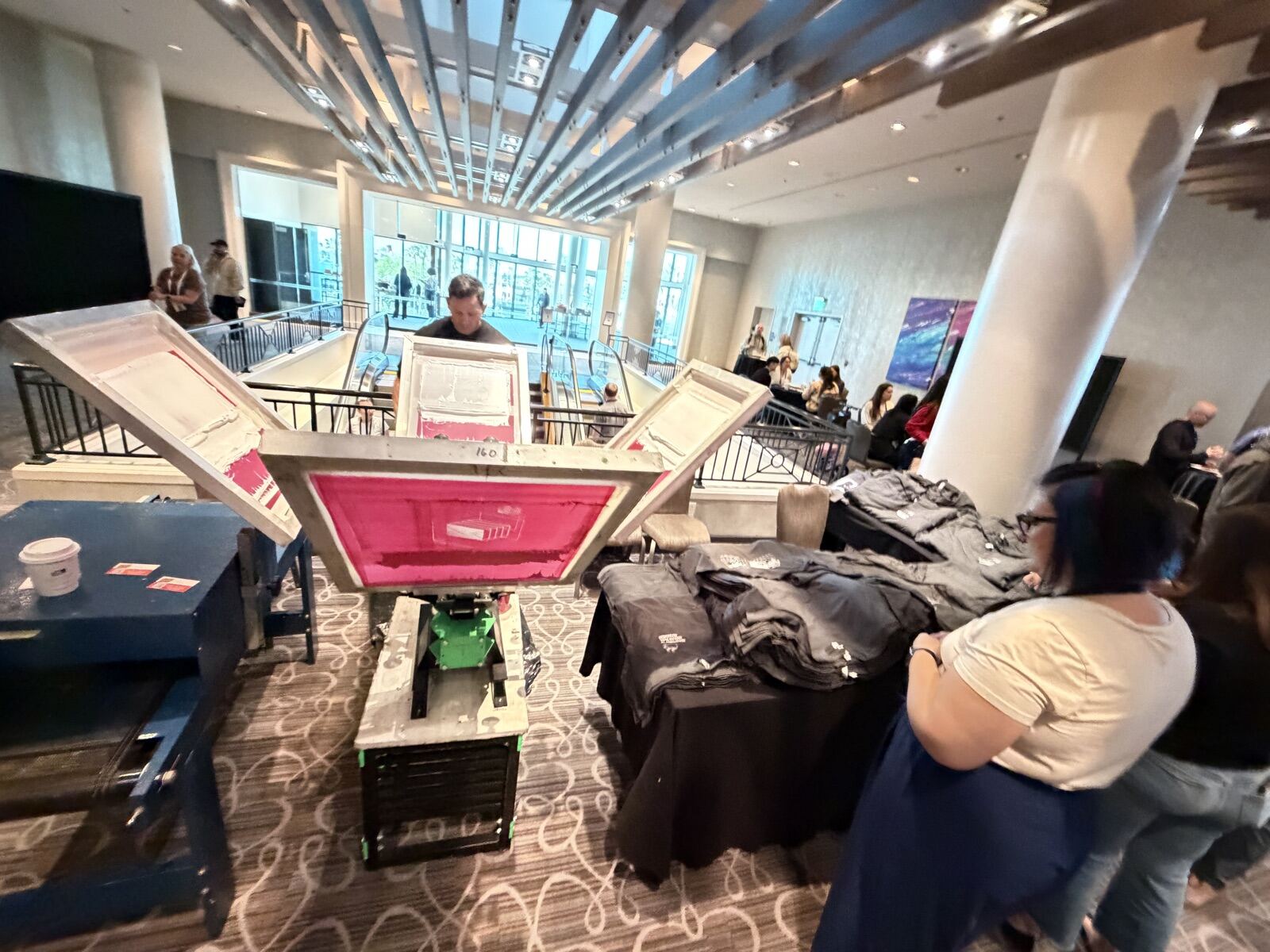
Step 4: The floor plan
- Footprint: 10×20 for a two-press island — presses centered, garment wall behind, menu boards facing the approach.
- Queue path: along the garment wall, so waiting guests pick sizes and designs before reaching the press. The wait does the prep work.
- Power: two dedicated 120V/20A circuits. In hotels, that's a house electrician request; in convention halls it goes on the power order form. We handle both.
- Handoff table: downstream of the presses, with folding and a photo-op backdrop if the event wants the content moment.
Step 5: The timeline
- T-3 weeks: artwork locked, garments ordered.
- T-1 week: transfers produced and QC'd; size curve confirmed against final headcount.
- Event day, H-2: load in, build the island, test press on spare blanks.
- H-0 to H+1.5: full crew of four; surge mode.
- H+1.5 to close: rotate to three crew; begin quiet pack of empties.
- Close +1 hr: strike complete, leftover garments handed to the client — they make great follow-up gifts.
Step 6: Staff the island by role, not headcount
Four crew for the surge, but the roles matter more than the number. Two press operators keep both machines cycling — alternating loads so one platen is always closing. One garment runner owns the wall: pulling sizes, flagging when a size drops below ten units, restocking from backstock cases under the table. One host works the front of the queue with the menu board, so every guest arrives at the press already knowing their design and size — that single role is worth 20–30 extra garments an hour, because the press never idles while someone decides. After the surge, the host role folds into the runner and you're down to three without the line feeling it.
The three numbers to watch mid-event
Once doors open, the plan reduces to three live gauges. Queue depth: more than 15 people waiting means the host starts pre-staging picks two guests deep. Transfer burn rate: if the funny design crosses 60% consumed before the halfway mark, we quietly re-split the remaining stock and the menu board gets a “limited” tag — scarcity reads as cool, running out reads as failure. Size-wall depletion: when L or XL hits its last case, leftover blanks shift toward the photo-op table so the wall never looks picked over. Your producer tracks all three; you'll just see a line that keeps moving.
Scaling this worksheet up or down
The 500-guest shape flexes cleanly. At 150 guests over three hours, drop to a single press with two crew and a six-foot garment table — the 10×20 island becomes a 10×10. At 1,000 guests, don't double the island; split it into two two-press stations at opposite ends of the floor, because one giant queue reads as a wait while two short ones read as energy (a pattern we lean on for expos). The constants that never change: the surge lands in the first ninety minutes, the queue path runs along the garment wall, and every press wants its own dedicated circuit.
What it costs
A local two-press program in this shape typically lands in the mid four figures to low five figures depending on garment choice — anchored by stations from ~$5,000, staffing at $250/hr, and blanks at wholesale. Outside OC, LA, or San Diego, add a flat $900 travel fee. Pricing details here, or send your date and get the real number for your venue.